
How We Verify Information and Reach Our Assessments
A promotional promise, a published condition and a verified real-world outcome are not the same thing. At levelupcasino-1.com, our aim is to make that distinction clear and explain the evidence behind each conclusion.
For every topic, we identify the questions that matter to readers, check individual details and show what we could establish and what remains unknown. We then explain how those findings affect a decision about a particular offer or feature.
This does not guarantee that every assessment is error-free. The methodology is designed to make the evidence and limitations behind each assessment easier to understand.

What Our Verification Process Is Based On
We distinguish between five things:
- The claim being checked: exactly what we need to find out.
- The evidence found: what the available sources tell us.
- The origin of the information: who published it and whether the source is appropriate for the question.
- The verification status: whether the supporting evidence is sufficient.
- The practical conclusion: what the findings mean for the reader.
A specific figure in an article outline or promotional description is not evidence in itself. It raises a question for verification but does not determine the answer.
Results are recorded in a central fact database, together with the value, status, source, date and any important qualifications.
What We Check
The questions depend on the subject of the page. For an article about a bonus, the key issues are the conditions for claiming and using it. For an article about the mobile experience, they are access methods, compatibility and restrictions.
We generally select 5–8 significant factors. These may include:
- the operator and licensing;
- bonus terms, wagering requirements and expiry dates;
- deposits, payment methods and withdrawals;
- identity verification (KYC);
- availability of games and individual features;
- customer support;
- the mobile version; and
- regional restrictions.
This is not a mandatory checklist applied to every article. We select the factors that genuinely affect the decision relevant to the topic, with Australian readers in mind.
One Factor Can Involve Several Separate Checks
“Bonus terms” are not one single fact. The bonus amount, wagering requirement and expiry date are separate details. Each is checked individually and assigned its own status.
Confirming an amount does not automatically confirm the expiry date or conditions of use. Likewise, mentioning one detail in several sections of an article does not turn it into several separate checks.
How We Decide Which Factors Matter Most
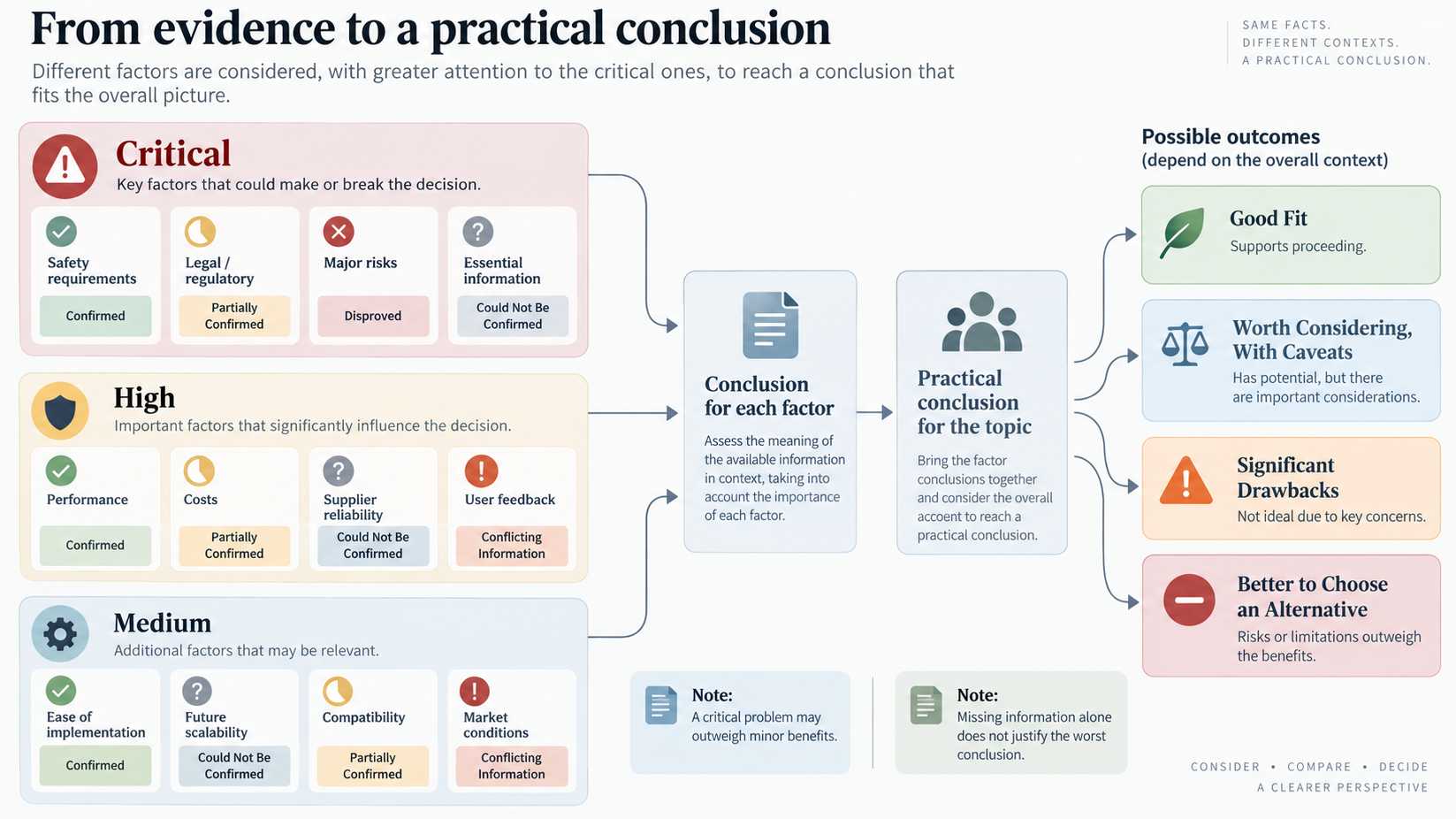
A factor’s importance depends on how much its outcome could change the reader’s decision.
| Priority level | What it means |
|---|---|
| Critical | The result on this issue could change the decision on its own. |
| High | It significantly influences the choice but must be considered alongside other conditions. |
| Medium | It helps compare options but rarely determines the decision by itself. |
A priority level is not a verification status. A critical question may remain unanswered, while a minor feature may be fully confirmed.

How We Choose Sources
We assess more than a website’s reputation. We consider how well a particular document answers the particular question being asked.
| What we check | Suitable sources |
|---|---|
| Licensing and legal status | Registers and information published by the relevant regulators. |
| Bonus terms, wagering requirements, expiry dates and betting limits | Promotion rules, Bonus Terms and Terms & Conditions. |
| Published payment conditions | Payment pages, withdrawal policies and help centres. |
| Game features | Provider documentation and information about the specific version of the product. |
| Real-world experiences: delays, KYC, account blocks and support | Independent review platforms, complaints and relevant specialist discussions. |
A source may suit one task but not another. An operator’s terms can establish a published limit, but they cannot, on their own, prove that every withdrawal is processed without delay. A user review might describe a delay, but it does not replace the official rules governing limits.
Official Does Not Mean Suitable for Every Claim
Official sources include the operator, regulator, official register, provider and their documents. A review website, forum, aggregator or mirror site does not become official simply because its address contains a brand name or its design looks similar.
Even an official document is not evidence for every possible claim. We must check whether it applies to the relevant offer, region, period and product version.
How We Consider User Experiences
One review is an individual signal, not a basis for a general conclusion. Several similar reports may suggest a pattern. A recurring pattern across separate independent platforms provides stronger grounds for an assessment.
However, copies of the same post are not counted as multiple independent accounts. We also consider how specific the account is, when it was posted and whether the circumstances differ.
Product Features and Operator Availability Are Different Facts
Documentation may confirm that a particular game or app has a certain capability. That does not prove a specific casino offers that version or that it is available to users in Australia.
These claims require separate checks.
Why a Brand’s Claim Is Not Independent Confirmation
If an operator publishes a promise, that confirms the promise was made. It does not necessarily confirm that the promise is fulfilled in practice.
For example, a published withdrawal processing timeframe and the actual time it takes each customer to receive funds are different questions. The first requires the relevant terms. The second cannot be established from the operator’s statement alone.
Where information comes only from the brand, we make its origin clear. If a claim needs independent confirmation and none is available, we use either “Partially Confirmed” or “Could Not Be Confirmed”, depending on the evidence.
There is no need for a separate sixth status for brand claims: the limitation is explained alongside the finding.
What Our Verification Statuses Mean
Confirmed
Sufficiently reliable evidence directly supports the specific detail under the stated conditions.
The status applies to that detail only, not to every characteristic of the casino or offer.
Partially Confirmed
Some information has been established, but an important condition, range or area of application remains unclear.
We show exactly what has been confirmed and what is still missing.
Could Not Be Confirmed
The available evidence is insufficient to reliably establish or confirm a value.
This does not automatically mean the claim is false or the feature does not exist. A value might appear in a source without enough evidence to verify it. In that case, we retain the reported value with a clear qualification.
If no value could be established at all, we state that explicitly.
Conflicting Information
Relevant, credible sources provide incompatible information, and we cannot establish one reliable version.
We show the discrepancy instead of selecting whichever version best suits the conclusion.
Disproved
A specific, testable claim was examined, and sufficiently reliable evidence directly showed that it was incorrect.
We do not apply this status simply because information could not be found. “Could Not Be Confirmed” and “Disproved” are different outcomes.
A Real Example: An A$10 Deposit Offer
The saved LevelUp Casino fact database includes a check for a separate free-spins promotion tied specifically to an A$10 deposit. The record is dated 4 October 2026.
What We Checked
Whether a separate free-spins offer exists specifically for an A$10 deposit.
That is a question about a promotion, not simply whether a deposit of that amount can be made.
What We Found
The saved record states:
No separate free-spins offer specifically for an A$10 deposit was established.
The record cites the lvlup.casino payments page as its source. We are reporting the saved verification result here, not claiming that the page’s contents were checked again when preparing this example.
How We Compared the Information
A payment condition is not the same as a bonus offer. Even if a particular deposit amount is permitted, confirming a promotion requires terms that explicitly link that deposit to a particular reward.
The saved record provides no basis for making that leap.
Which Status We Assigned
Could Not Be Confirmed. The database uses the equivalent wording “Not Confirmed”.
The reason: a separate promotion specifically for an A$10 deposit was not established. That is not enough to promise a bonus or to conclude that no such promotion could possibly exist.
What It Means for Readers
Do not assume that free spins are included solely because of the deposit amount. Before taking part, you should be able to see the specific promotion’s terms: who is eligible, what it offers and what restrictions apply.
This example illustrates an essential distinction: related details are not interchangeable.
What We Do When Sources Disagree
When researching a new detail, we compare the dates, regions, conditions and subject of each claim. Sometimes an apparent contradiction can be explained by different promotions, payment methods or product versions.
We then consider which source is closest to the primary evidence for that particular question and look for additional information.
If the discrepancy remains, the result receives the status “Conflicting Information”. We do not average incompatible figures or choose the one that looks better in the article.
If new information conflicts with a previously saved fact, that triggers a separate review. It is not a reason to quietly replace the data while writing the next article.
Why We Use a Central Fact Database
The same detail may be needed on several pages. To prevent each new article from producing its own version of the answer, we use a saved record.
The rule is straightforward:
- if the relevant fact is already recorded, we use its value, status and qualifications;
- if the fact is not recorded, we research it and add the result; and
- publishing a new article should not, by itself, overwrite an existing fact.
This also applies to “Could Not Be Confirmed” and “Conflicting Information”. Uncertainty should not disappear simply because the same question comes up in another article.
We check whether two records genuinely concern the same circumstances. Different regions, products or promotions cannot be merged merely because their names are similar.
This approach supports consistency across articles. It does not mean every previously published page automatically synchronises with the database or that discrepancies are impossible.
Why the Verification Date Matters
Bonuses, wagering requirements, payment methods, limits and game availability can change.
A saved fact reflects what was checked on a particular date; it is not a promise that the information will remain current forever. Preparing a different article does not count as rechecking that fact.
Changing a saved result should be a separate task supported by new evidence, with a review of the articles that used the previous information. Otherwise, one page could keep the old figure while another shows a new one without explaining why.
What the Verification Percentage Means
The percentage indicates how much of the information selected for checking has been verified. It is not a measure of casino quality.
For each factor, the following values are assigned:
| Status of the detail | Contribution |
|---|---|
| Confirmed | 1 |
| Partially Confirmed | 0.5 |
| Conflicting Information | 0.5 |
| Could Not Be Confirmed | 0 |
| Disproved | 0 |
The total is divided by the number of all details checked within that factor, then multiplied by 100%.
Unknown details remain in the calculation. We do not leave a question out just because an answer could not be found. Otherwise, the percentage would reflect only the convenient parts of the research.
Here is a hypothetical calculation, not an assessment of LevelUp Casino: of four details, two are confirmed, one is partially confirmed and one could not be confirmed. The result is:
The overall percentage for the page’s topic is the arithmetic mean of the percentages for its critical factors. Each critical factor carries equal weight in this calculation.
What This Percentage Does Not Mean
It is not the probability that a casino is safe, that a player will win or that a withdrawal will be trouble-free. It is not a guarantee of reliability, a legal assessment or an overall quality rating.
A low percentage may mean that much of the necessary information could not be verified publicly, rather than that the service is poor. To understand why, you need to look at the statuses. Missing evidence, conflicting information and direct disproof mean different things, even though all can reduce the percentage.
Assigning half a point to conflicting information also does not mean a claim is “half true”. It is simply a rule for the calculation, and the discrepancy must still be considered separately.
How We Reach an Overall Conclusion
First, we review the results for each individual detail. We then form a conclusion about each factor: what has been established, which conditions matter, where uncertainty remains and how it affects the decision.
After that, we select one of four overall conclusions for the specific topic of the page.
| Conclusion | When it applies |
|---|---|
| Good Fit | Critical requirements are met, no serious unresolved conflicts remain, and drawbacks mostly concern less important aspects. |
| Worth Considering, With Caveats | No serious failure of a critical factor has been established, but important restrictions or substantial uncertainty remain. |
| Significant Drawbacks | A serious problem has been established for a critical factor, several important factors fail to meet requirements, or restrictions noticeably undermine the offer. |
| Better to Choose an Alternative | There is sufficient evidence that a critical requirement is not met, that a material contradiction exists, or that another issue undermines the offer in relation to the page’s topic. |
We do not reach the last conclusion solely because information is unavailable.
How Priority Affects the Conclusion
We consider critical factors first, followed by high- and medium-priority factors. A serious problem with a critical issue may outweigh several positive findings about less important features.
We do not add mathematical weights or assign an overall score out of ten to reach this conclusion. The verification percentage and the practical assessment serve different purposes: the first describes the strength of the evidence base, while the second explains what the findings mean for the decision.
The conclusion applies to the topic of that specific page, not to every aspect of the platform. The existence of a weaker competitor does not improve our assessment of the offer under review.
What We Do Not Do
Under this methodology, we must not:
- treat a promotional promise as proof that it has been fulfilled;
- hide unknown values or material conflicts;
- fill gaps with assumptions;
- upgrade a verification status to make an article sound more convincing;
- choose a source simply because it produces a convenient answer;
- describe a third-party website as official;
- use reviews in place of documents setting out formal conditions;
- treat a lack of information as proof that a feature does not exist;
- claim first-hand testing if none was carried out; or
- strengthen or soften a conclusion merely to create an impression.
Limitations of the Methodology
Not all information is publicly available. Some terms can only be viewed after registration or depend on a user’s location, a particular offer or individual circumstances.
Primary documents may be incomplete or ambiguous. Independent evidence about how a service actually operates may be limited. Conditions may change after the verification date.
A status therefore reflects the evidence available at the time of checking. It does not guarantee the same outcome for every user and does not replace reading the current terms before making a decision.
The methodology also cannot eliminate the possibility of mistakes when finding information, comparing sources or preparing an article.
About the Project and Source Transparency
Background about the project is available on our author page. Here, we describe how we verify information without substituting claims about qualifications, team size or guaranteed independence for an explanation of the process.
Source links allow readers to see where a particular claim came from, open the original document and understand the limits of the evidence.
Our own article presents the results of working with sources, but it is not independent confirmation of itself. If a fact appears in several of our articles, it is still one saved verification, not several new pieces of evidence.
The guiding principle is to help readers distinguish what is known, what supports it, what remains uncertain and why the evidence leads to a particular conclusion.